
Watch or Listen
When Judgment Falls: What Genesis 6 Teaches Us About Grace Under Pressure
When judgment falls, most of us are caught completely off guard, not because the warning signs were absent, but because we stopped believing they meant anything. Think about what happens when a fire alarm goes off in a crowded building. We rarely rush for the exits. Instead, we look around at the people next to us and wait to see if anyone else is panicking. We assume it is a drill, a glitch, a false alarm. Genesis 6 is the moment the ceiling comes down, and the alarm was real the entire time.
This chapter crashes into our cultural comfort zone and confronts us with three realities we would rather not face.
When Judgment Falls: The Delusion of Consequence-Free Living
Genesis 6 opens with a season of rapid human expansion. Rather than filling the earth with the image of God as they were designed to do, humanity used that expansion as cover for something far darker. Boundaries God had ordained were openly and collectively crossed. For the first time in the biblical narrative, we see a widespread, shared corporate sin where a whole civilization is reaching for power and forbidden pleasure at the same time.
This arrogance has a historical echo. In 1889, the wealthy elite of a private hunting club in Johnstown, Pennsylvania, lowered a massive dam to accommodate their carriages. They simply assumed the rules of nature did not apply to them. When the rains came, the dam failed, and a wall of water killed over 2,200 people downstream. The people below the dam paid the price for the arrogance of the people above it.
Genesis 6 delivers the same warning. When judgment is delayed, we tend to mistake God’s patience for His permission. We build our own pantheons of cultural heroes and treat them as though they are above consequence. However, boundaries cannot be crossed forever without a cost, and the lines crossed in Genesis 6 are a mirror held up to our own moment.
The Deep Distress of Our Designer
God looked down and saw that every intention of the thoughts of the human heart was only evil continually. That word for intention in the original Hebrew comes directly from the potter’s verb. It is the word used to describe God forming Adam from the dust. Humanity had hijacked that same creative capacity. Rather than forming beauty, man had become the potter of his own soul, constantly shaping ugly schemes in the workshop of his mind.
Moreover, verse 6 tells us that the Lord regretted having made humanity and that it grieved Him to His heart. This is one of the most striking statements in the entire book of Genesis. God is not a detached clockmaker observing His creation from a distance. He is a Father who experiences the genuine suffering of watching His children destroy themselves. Human rebellion causes the Creator immense grief and literal pain. He is not angry at us from the outside. He is grieved because He loves us and we are breaking ourselves against the very boundaries He set to protect us.
When Judgment Falls, Grace Builds an Ark
In the midst of rising corruption, Noah found favor in the eyes of the Lord. Significantly, that favor came before his obedience, not because of it. Grace was the engine driving everything Noah did. His righteousness was the fruit of a favor he had already received, which means the pattern of Genesis 6 is the same pattern that saves us today.
God responded to that grace relationship by providing Noah with a specific architectural blueprint for survival. He instructed Noah to cover the vessel inside and out with pitch. That word pitch carries the same Hebrew root as the word for atonement. In other words, this substance was a picture of the covering that stands between the passenger and the judgment pressing in from outside.
Consider what happened in 2013 when a tugboat capsized and sank one hundred feet to the ocean floor. A cook named Harrison O’Keefe survived in a tiny air pocket for sixty hours. When rescue divers finally found him, he faced a serious problem. He could not simply swim to the surface because the sudden change in pressure would have been fatal. So the divers lowered a sealed vessel, called a diving bell, that could carry him through a depth he could not survive on his own.
Jesus Christ is our diving bell. He descended into the depths of our broken world and took the full pressure of judgment upon Himself. Furthermore, He provides the only covering strong enough to carry us safely home.
Securely Shut In
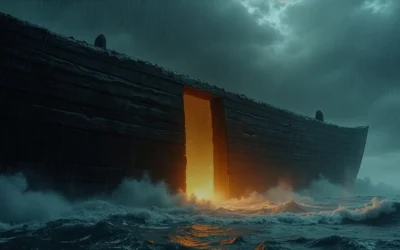
After Noah finished his labor and loaded the animals, the Lord shut him securely inside the ark. Noah did not pull the latch himself. God sealed the door.
That detail matters for our understanding of our own salvation. We live in a culture with intense spiritual pressure on every side, and we cannot survive it through personal effort or moral management. The security we need is not something we construct. It is something we receive. Therefore, the invitation of Genesis 6 is the same invitation that runs through the entire Bible: stop hiding, stop building your own walls, and step into the covering God has already provided through His Son.
Take This With You
Reject the lie of consequence-free living.
Limit your screen time and reduce your exposure to the digital voices that normalize crossing God’s boundaries. Cultural influencers are not above the judgment of God, regardless of their reach or platform.
Open the Scriptures daily.
Let the Word of God function as a boundary marker that keeps you oriented toward what is true and safe. Consistency here matters more than length or volume.
Abandon self-reliance.
Bring your full, unedited self into the light rather than building fragile walls to hide your struggles. The Potter already knows what is in the workshop of your heart.
Pray Through This
- Ask God to reveal the specific areas where you are hiding rebellion against Him rather than bringing it into the light.
- Pray for the true Potter to heal the places in your heart that human effort has only managed to conceal.
- Thank God for providing Jesus as the secure door and the ultimate refuge from judgment.
This sermon is part of the series Foundations: The DNA of Creation at Central Baptist Church in Maysville, Kentucky. New messages post each week.
More from the Foundations Series
Finding Grace in the Flood
Finding grace in the flood means seeing past the children’s story to the shelter, the waiting, and the worship at the heart of Genesis 7-8. A sermon on what Noah teaches us about rescue, trust, and the sacrifice of Christ.

A Reminder of Our Brokenness
The Genesis 5 meaning goes deeper than names and ages. This sermon on Enoch, Lamech, and Noah reveals what the genealogy teaches about death, exhaustion, and the rest only Jesus gives.

Design Over Desire
Feeling lost in the chaos? Discover why trusting God’s design over desire brings true clarity, freedom, and purpose to your life.
About Adam
Adam Burton is the pastor of Central Baptist Church in Maysville, Kentucky, and serves as a police chaplain. He’s passionate about helping people build a faith that lasts through practical, gospel-centered teaching.
Want more content like this?
Join the newsletter for weekly encouragement and practical discipleship resources.
You can unsubscribe anytime. For more details, review our Privacy Policy.